

2025-12-12
National Assembly Passes the Law Amending and Supplementing Certain Provisions of the Law on Insurance Business: A Shift from “Ex-Ante Control” to “Risk-Based Supervision”
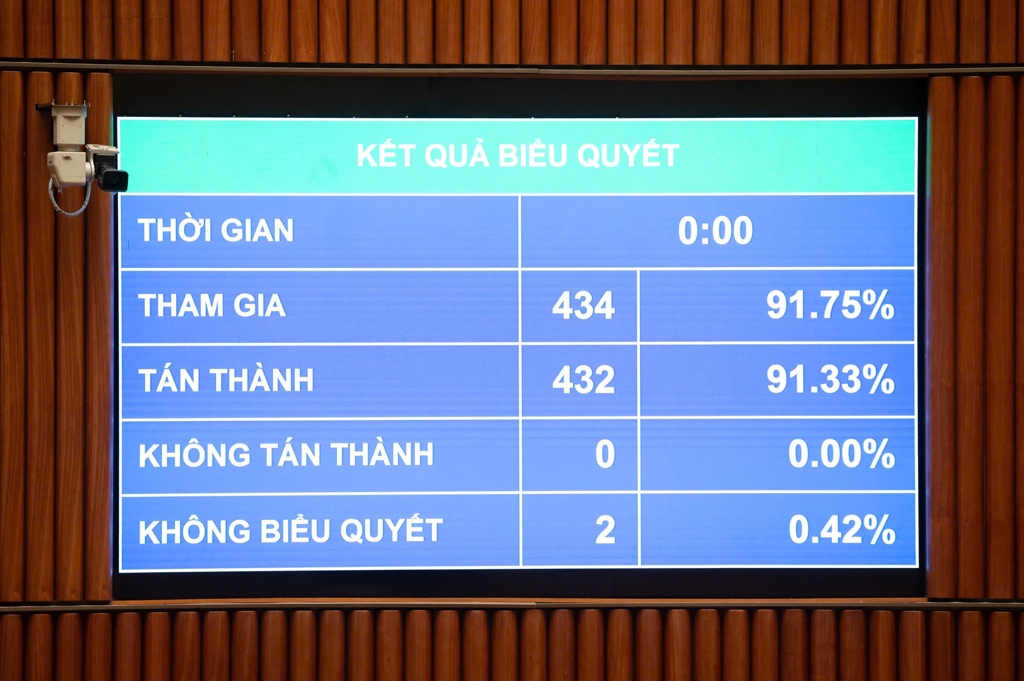
On December 10, 2025, at the 10th Session of the 15th National Assembly, the National Assembly officially passed the Law amending and supplementing certain provisions of the Law on Insurance Business, with a high approval rate. The Law is enacted in the context of Vietnam’s insurance market entering a period of restructuring, improving governance quality, and further aligning with international practices.
According to the Ministry of Finance, the amended Law aims to simplify investment and business conditions, reduce unnecessary administrative procedures, and marks an important shift in regulatory thinking toward the insurance market—a financial sector that plays an increasingly significant role in economic stability and social security protection.
Significant Reduction in Ex-Ante Requirements, Stronger Ex-Post Supervision
One of the notable features of the amended Law is the removal and simplification of many ex-ante regulatory requirements for insurers, reinsurers, and market participants.
Many requirements that previously required prior approval from the Ministry of Finance have now been shifted to a mechanism under which enterprises assume greater responsibility and are subject to ex-post supervision. This approach aligns with policies aimed at improving the business environment, enabling enterprises to be more proactive in their operations while reducing compliance costs.
Standardizing Conditions for Market Entry and Participation
The amended Law removes certain formalistic and impractical requirements, particularly for foreign investors. Notably, the regulation requiring confirmation from foreign supervisory authorities that an enterprise has not committed serious violations of insurance laws has been abolished, helping to address obstacles arising in the process of attracting investment and fostering international cooperation.
In addition, conditions applicable to managers, controllers, and professional positions have been adjusted toward greater flexibility, in line with the realities of Vietnam’s insurance workforce, while continuing to ensure standards of professional competence and ethical conduct.
Enhancing Autonomy in Insurance Operations
The amended Law continues to affirm the principle that insurance enterprises may proactively develop, design, and implement products, while remaining responsible for ensuring the adequacy, transparency, and financial soundness of such products.
For certain lines of business, particularly non-life insurance, the process for approving methods and bases for premium calculation has been simplified, shifting from an approval mechanism to a notification mechanism, enabling enterprises to respond more promptly to market and customer needs.
Simplifying Regulations on Organizational Structure and Internal Governance
The amended Law also clarifies and harmonizes definitions related to branches, representative offices, and business locations, facilitating enterprises in expanding their operational networks.
Certain regulations on the concurrent holding of managerial positions have been adjusted toward greater flexibility, helping to ease organizational constraints, particularly for enterprises with lean operational models.
Roadmap for Transition to the Risk-Based Capital (RBC) Model
The Law introduces a clear roadmap for transitioning to risk-based capital requirements. Enterprises may concurrently apply both the traditional capital model and the RBC model until the end of 2030; from 2031 onward, the RBC model will be uniformly applied.
Effective Date and Implications for the Market
Under the new provisions, the Law amending and supplementing certain provisions of the Law on Insurance Business will take effect on January 1, 2026. Certain provisions related to insurance auxiliary services will take effect from July 1, 2026, to ensure consistency with the amended Law on Investment.
The National Assembly’s adoption of the amended Law is considered an important policy milestone, contributing to the improvement of the legal framework for the insurance market toward greater transparency, efficiency, and alignment with international practices. It also provides a solid foundation for insurance and reinsurance enterprises, including Hanoi Re, to further enhance governance capacity, proactively adapt to regulatory changes, and pursue sustainable development in the coming period.